A week of big numbers and fine science. Global investment in the space economy came within reach of breaking the US$100 billion mark in a single year for the first time, Blue Origin confirmed a US$10 billion round and a US$550 million satellite factory, and Europe debated in Parliament how to fund and protect its own satellite connectivity. Meanwhile, ALMA detected a never-before-seen molecule in space from Chile, Webb pinned down the most distant fast radio burst known, and NASA released 800 GB of Artemis II lunar data.
Economy, investment and industry
1. Space economy investment is on track to top US$100 billion in 2026
According to Space Capital's quarterly report, global investment in the space economy reached US$92.5 billion in the first nine months of 2026 and is on track to cross US$100 billion for the full year, a record that would surpass the 2025 mark. The most striking data point is Europe's weight: US$6.3 billion in the third quarter — a record quarter for the second time in a row and 28% of global investment — for a nine-month total of US$13.5 billion. The launch segment explains much of the jump: pure-play launch companies raised US$7.8 billion this year, Stoke Space closed a US$1 billion Series E, and Blue Origin took outside capital for the first time in 26 years. The report also flags a supply-side strain: SpaceX stopped accepting rideshare reservations beyond late 2028, precisely when much of the industry depends on its Falcon 9 fleet. Read the story (The Tribune / ANI) and Bloomberg's coverage.
2. Blue Origin: US$550 million in Texas, a US$10 billion round and a path to the public markets
On October 8 Blue Origin announced Constellation Park, a 120,000 m² satellite manufacturing complex in Hutto, Texas, with a US$550 million investment and projections of up to 2,000 jobs in advanced manufacturing and engineering over ten years. Construction begins in early 2027. A day earlier, Jeff Bezos had confirmed a US$10 billion primary round — the first time the company has taken outside equity — which according to the Wall Street Journal values it at around US$140 billion, and said he expects Blue Origin to become a publicly traded company, though an IPO is "possibly several years from now." The plant will build the satellites for TeraWave, the 5,408-satellite low- and medium-Earth-orbit constellation designed to deliver up to 6 Tbps of symmetrical backbone connectivity to enterprise and defense customers, with first launches targeted for late 2027. Read the story (SatNews).
3. Czech industrial group CSG buys 9.5% of MDA Space and becomes its largest shareholder
Czechoslovak Group (CSG), an industrial and defense group listed in Amsterdam, announced on October 13 its entry into the space sector by acquiring a 9.5% stake in MDA Space (Toronto and New York), making it for now the largest shareholder in the Canadian company. CSG did not disclose the price. The deal is held through a dedicated subsidiary and comes with a new in-house space team led by Ladislav Stahl, Filip Kocián and Cameron McKenzie. The group signalled it will seek cooperation with MDA on co-investment in European manufacturing and assembly, joint acquisitions and shared customer relationships. "We want to be a long-term strategic shareholder," said CSG chairman Michal Strnad; MDA Space CEO Mike Greenley called CSG a strategic investor. Read the release (GlobeNewswire).
4. Europe debates satellite sovereignty, spectrum and the post-2027 space budget
Regulators, EU officials and Spanish operator Sateliot met at the European Parliament on October 13 to discuss spectrum and funding for Europe's space networks. The context is the end of a cycle: the EU space programme for 2021-2027 holds €14.8 billion (Galileo and Copernicus) and expires in 2027. For 2028-2034 the Commission proposes funding space inside a European Competitiveness Fund, with €131 billion earmarked for defense and space. On spectrum, the Commission proposed in May a single EU-wide licence in the 2 GHz band — current rights expire in May 2027 — with part of it reserved for European operators and for a secure system tied to IRIS², the constellation with which the EU answers Starlink. Sateliot, selected by ESA in September for IRIS²'s Low-LEO layer, launched five satellites on the October 1 Transporter-18 mission (11 in total), is raising €150 million in equity and debt, and plans to exceed 500 satellites by 2028. Read the story (Euronews).
5. Balerion passes US$200 million on Fund II and points to power as the bottleneck
Dallas-based venture firm Balerion Space Ventures confirmed that Fund II has surpassed its US$200 million target and remains open: it is more than five times the size of its debut vehicle, which closed at just under US$40 million. The thesis has shifted: beyond space infrastructure and supply chains, the fund has expanded into nuclear and fusion. "Power is at the bottom of all tech stacks," co-founder Daniel Kleinmann said. The fund has backed 15 companies so far, among them Vast, Relativity Space, Dawn Aerospace, Valar Atomics and Commonwealth Fusion Systems, and is reserving capital for follow-on rounds. Balerion also brought in former NASA Chief Technologist A.C. Charania as managing director to lead global operations, with growing focus outside the United States: India, Japan, Israel, Australia, New Zealand and Europe. Read the story (Payload).
6. Kapta Space raises US$24 million for low-cost satellite radar
Seattle startup Kapta Space closed a US$24 million Series A on October 9, bringing total funding to US$30 million. Washington Harbour Partners (a defense tech investor) led, with Bison Ventures co-leading and participation from MetaVC Partners — the metamaterials fund backed by Bill Gates and Nathan Myhrvold, which had led its US$5 million seed — plus MYDA Capital, Entrada Ventures, Aurelia Foundry and Fitz Gate Ventures. Founded in 2023 by Milton Perque and Adam Bily (both former Echodyne engineering leaders), the company is developing a metamaterial electronically scanned array (MESA) architecture to make steerable satellite radar far cheaper, lighter and less power-hungry than conventional systems, aimed at persistently tracking moving air, sea and land targets. The money goes to manufacturing, spaceflight qualification and initial orbital demonstrations. Read the story (GeekWire).
7. Fortastra adds US$30 million for maneuverable orbital security spacecraft
Fortastra announced a US$30 million Series A led by First In, with participation from Upfront Ventures, Space Capital, Rsquared, Side Door Ventures, ATX Ventures and existing investors. The company builds highly maneuverable spacecraft for on-orbit security: vehicles that operate near strategically important space assets, monitor nearby activity and can respond to potential threats. Its first platform, Watchdog V0, is already in orbit — it went from seed financing to an operational spacecraft in about a year. The capital will accelerate development and commissioning of its next security spacecraft, expand engineering and operations, and advance autonomy and manufacturing, with a stated goal of reaching "full-rate production." The company already holds initial government contracts and has an agreement with manufacturer Hadrian. Read the story (Pulse 2.0).
Science, exploration and missions
8. NASA and the Department of Energy sign a pact to take nuclear reactors to the Moon and Mars
On October 8, at the White House "Science: A New Golden Age" summit, NASA Administrator Jared Isaacman and Energy Secretary Chris Wright signed an agreement to accelerate cooperation on space nuclear power and propulsion. It creates a framework to jointly design, build and deploy nuclear systems and fuels, covering three fronts: Space Reactor-1 Freedom (SR-1), a nuclear electric propulsion spacecraft launching no earlier than 2028 on a Mars-bound mission; Lunar Reactor-1, a fission reactor to power the Moon Base, due to be launch-ready by 2030; and DOE-supplied radioisotope power and heater units for the Dragonfly rotorcraft and ESA's Rosalind Franklin Mars rover. The agreement came with no new funding and no cost estimates. At the same summit, Isaacman said NASA will beat the 2030 goal for the first Moon Base elements: the first is slated to launch in December, followed by near-monthly uncrewed robotic missions from early 2027. Read the story (Payload).
9. ALMA, in Chile, makes the first space detection of fully deuterated methanol
A team using the ALMA radio telescope in Chile's Atacama Desert announced on October 7 the first detection in space of fully deuterated methanol (CD₃OD): a variant of common alcohol in which all four hydrogen atoms have been replaced by deuterium, the heavy form of hydrogen. The molecule turned up around the protostar IRAS 4A2, in the Perseus molecular cloud some 1,000 light-years away. The finding — paper VII of the COMPASS programme, which surveyed eleven nearby young Sun-like stars — is a direct tool for reconstructing interstellar ice chemistry and the temperature conditions under which planets form: deuterium ratios work as a thermometer of the material's history. The study, led by Arnaud Belloche (Max Planck Institute for Radio Astronomy) within the programme run by Jes Jørgensen (Niels Bohr Institute), was published in Astronomy & Astrophysics. It is also another reminder of how much Latin American astronomical infrastructure carries frontier science. Read the release (ALMA Observatory).
10. Webb measures the distance to the farthest fast radio burst detected so far
On October 8, Science published the identification of the host galaxy of FRB 20240304B, the most distant fast radio burst detected to date. The millisecond pulse was caught by the MeerKAT array in South Africa; the Keck telescope found no visible source, and only the James Webb Space Telescope, with its NIRCam and NIRSpec instruments, found the galaxy: small and young, at a redshift of 2.148 — when the universe was about 3 billion years old. The galaxy type is the scientific key: it suggests these bursts come from young magnetars rather than neutron-star mergers. Along the way, the observations revealed a previously unknown galaxy cluster along the signal's path. The work is led by Manisha Caleb (University of Sydney), with J. Xavier Prochaska and Lordrick Kahinga (UC Santa Cruz) among the co-authors. Read the story (UC Santa Cruz) and the ESA/Webb release.
11. NASA releases 800 GB of Artemis II lunar science data
On October 7 NASA published more than 800 GB of lunar science data from Artemis II, much of it previously unreleased: over 11,000 full-resolution images and videos of the Moon, 8.5 hours of crew audio describing what they saw, and crew-annotated images. The material comes from the crew's handheld cameras — Reid Wiseman, Victor Glover, Christina Koch (NASA) and Jeremy Hansen (CSA) — and from Orion's cameras during the lunar flyby of April 6, 2026, flight day 6. The agency describes it as the first planetary science dataset captured primarily by humans in more than half a century, including crew markings of impact flashes on the dark lunar disk. Everything was uploaded to the Planetary Data System along with a preliminary science report, an operations report and a data user guide, and it is already feeding Artemis III planning. Read the announcement (NASA).
12. CRS-35 delivers the last pair of roll-out solar arrays and more than 40 experiments to the ISS
A Falcon 9 lifted off on October 13 at 6:33 a.m. EDT from Cape Canaveral with CRS-35, SpaceX's 35th commercial resupply mission for NASA, carrying more than 6,300 pounds (about 2,860 kg) of cargo and science. In the unpressurized trunk ride two ROSA (Roll-Out Solar Array) wings built by Redwire: the fourth and final pair bound for the station, each providing more than 20 kW with a service life above ten years, to be installed over a series of spacewalks. A version of the same technology will power NASA's SR-1 Freedom reactor, planned for 2028. The capsule carries hardware for more than 40 scientific studies, including biology and plant science and an experiment with exotic glasses made from elements heavier than silica, with refractive indices potentially above diamond's and greater break resistance — candidates for optics on lunar rovers and habitats. Booster B1096 landed at Landing Zone 40 on its eighth flight. Read the story (Spaceflight Now).
Argentina Space 2026: Argentina driving the New Space Economy
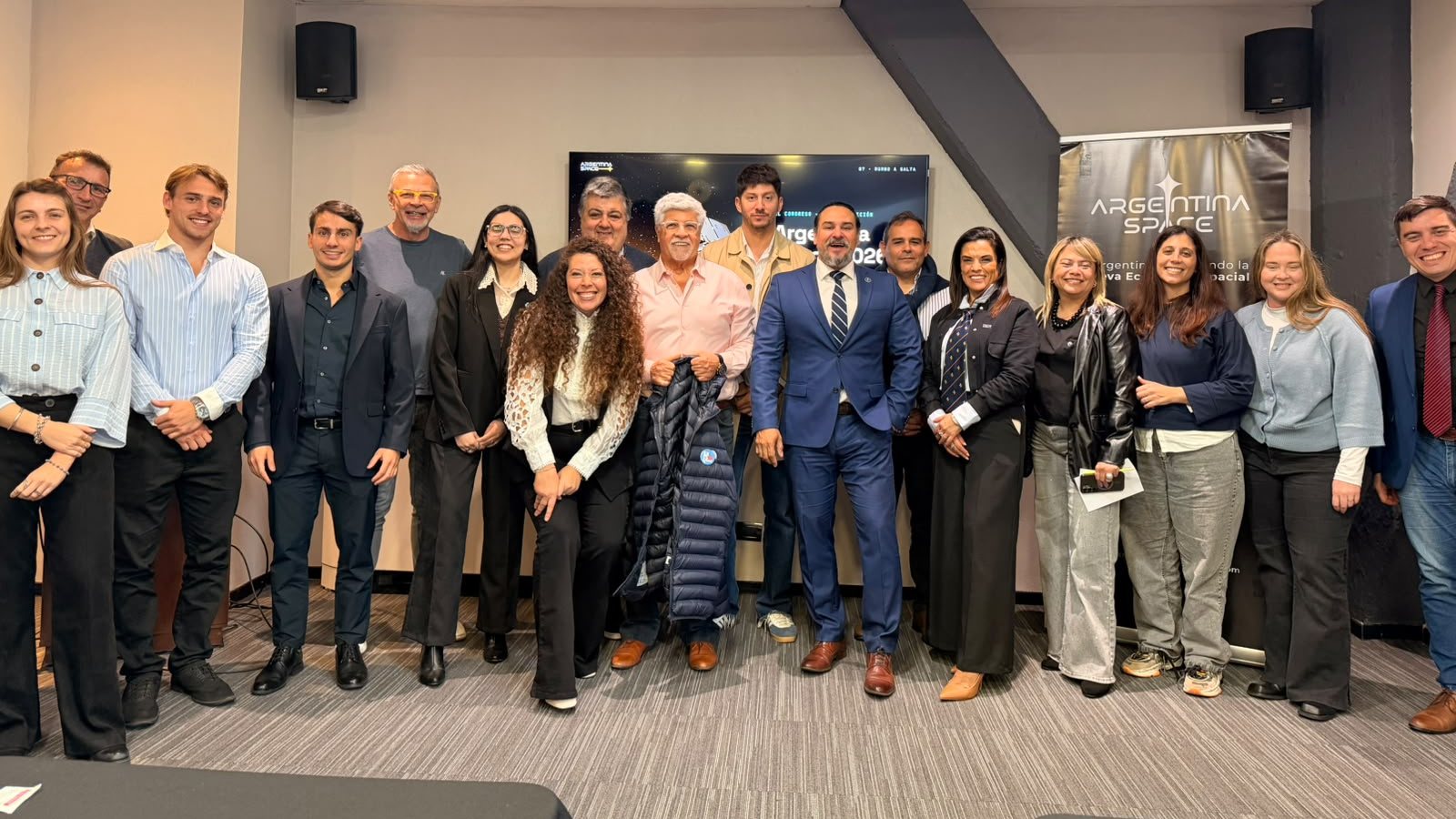
If global investment in the space economy is about to break US$100 billion and Europe already takes 28% of the total, the question for our region is simple: how much of that economy gets built here? That is the premise of Argentina Space 2026, the first major national gathering of the space, technology and science industry, bringing together agencies, companies, universities, startups and investors from Argentina and around the world.
- Dates: November 11, 12 and 13, 2026
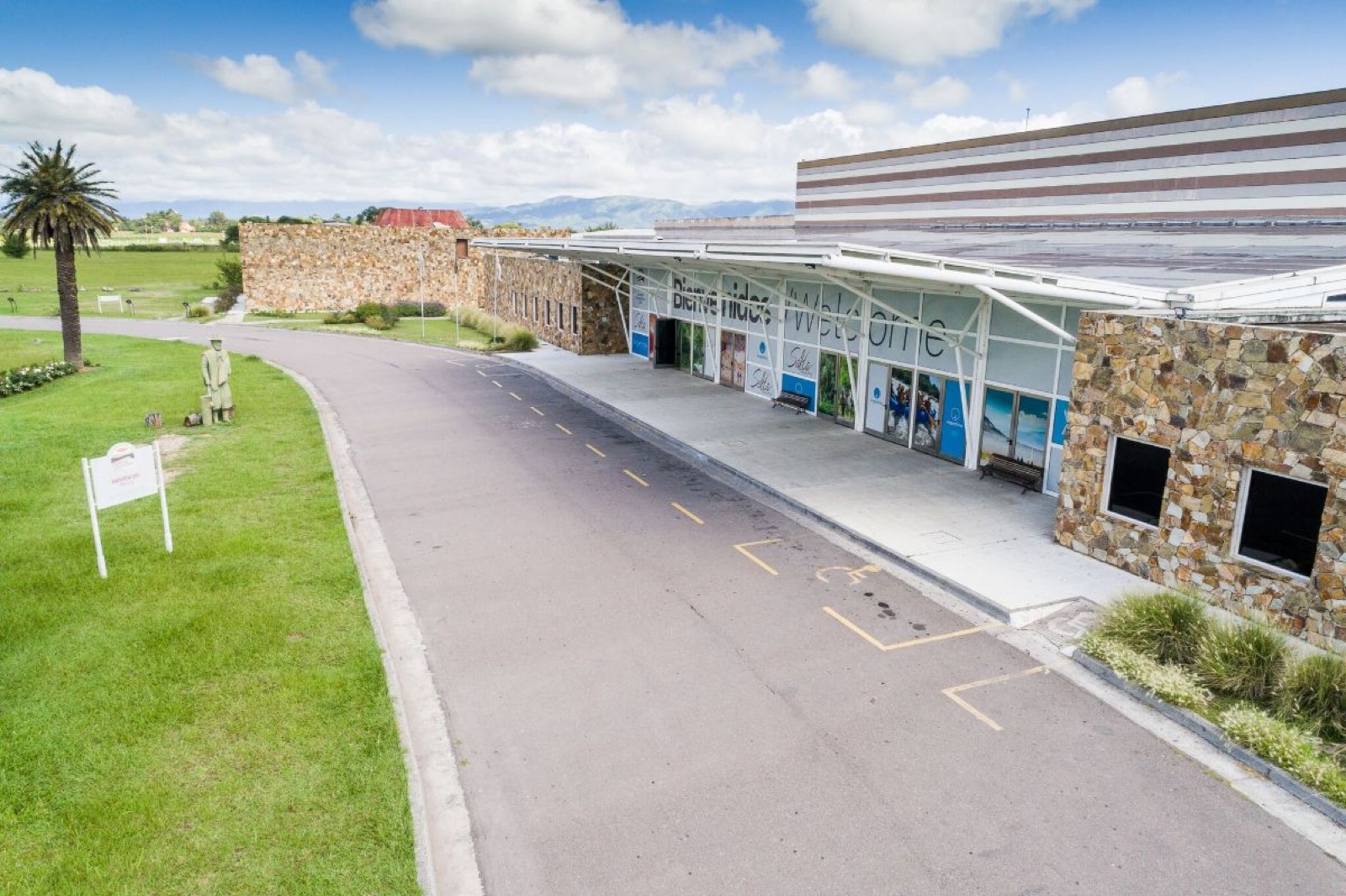
- Venue: Centro de Convenciones de Salta, Argentina
- Take part as: exhibitor, sponsor or attendee
- Contact: marketing@argentinaspace.com
Join Argentina Space 2026 on November 11, 12 and 13 at the Centro de Convenciones de Salta, and be part of the founding core of New Space in Argentina. More information: https://argentinaspace.com