A week that began at home: Argentina's 2027 budget bill put concrete figures on CONAE's table, and SABIA-Mar, the Argentine ocean-colour satellite, finally has a rocket. Abroad, capital moved at scale: a 2-billion-euro bid for the maker of the Vega rocket and a stock-market debut for an orbital mobility company.
In science, Euclid reached back to the universe's first 630 million years, BepiColombo arrived at Mercury with a scare along the way, and Webb reconstructed the merger of two stars in unprecedented detail.
Economy, investment and industry
1. Argentina's 2027 budget projects over $198 billion pesos for CONAE and promises to update the National Space Plan
Through Report No. 146 from the Chief of Staff's Office, the government confirmed three commitments to the Senate for 2027: updating the National Space Plan, continuing development of the ARSAT-SG1 telecommunications satellite, and allocating CONAE a budget credit of $198,113,102,773 pesos. The comparison matters: the current 2026 credit is $192,207,402,317, making the nominal difference $5,905,700,456 — a 3.1% increase in nominal terms, that is, below any expected inflation scenario. Of the projected total, $163,788 million pesos goes to the programme "Generation of Complete Space Information Cycles".
The report's other revealing figure is headcount, which has fallen steadily: 279 staff in 2023, 256 in 2024, 246 in 2025 and 227 in 2026, a 18.6% reduction and a net loss of 52 positions (which does not necessarily mean 52 dismissals). The government did not say when the Space Plan update would be approved or which new missions it would add. On ARSAT-SG1 — geostationary, Ka-band coverage, built by INVAP — the report offered no schedule update: the latest available information put its launch rescheduled to 2028 with service entry in 2029. The Chinese-Argentine CART radio telescope in Calingasta, San Juan, remains without a completion date at roughly 90% progress. All figures remain subject to legislative approval.
Source: Espacio Tech
2. SABIA-Mar has a rocket: it would fly on a SpaceX Falcon 9 in the second quarter of 2027
Last week we reported that the Argentine satellite had entered its final testing phase. Now the launch vehicle is known: SABIA-Mar would fly on a SpaceX Falcon 9 from the United States in the second quarter of 2027, according to information circulating in local media and statements by principal investigator Carolina Tauro. Caution is warranted: CONAE has not yet officially confirmed either the rocket or the date.
The economic detail is in the tender. CONAE opened international tender LPU 15-0001-LPU26 in April 2026 and bids were opened on 9 June. Montero USA Inc. bid US$26.5 million and the evaluation committee ranked it first, though the final award is not confirmed. Montero is linked to Epic Aerospace, and the report raises as an unconfirmed hypothesis that it could transfer a SpaceX launch reservation. Meanwhile, the satellite completed fabrication in 2026, passed its pre-environmental integration review in August and is in environmental testing at INVAP in Bariloche, with shipment to the United States planned for the first quarter of 2027. Its main instrument measures radiance reflected from the water surface across several spectral bands — phytoplankton concentration, productivity, water quality — at about 200 metres resolution for the regional scene and 800 metres for wider coverage, with a revisit of roughly two days. INVAP, VENG, CNEA, UNLP and others take part, and operations will run from the Teófilo Tabanera Space Centre in Córdoba. Direct precedent: SAOCOM 1A (2018) and 1B (2020) also flew on Falcon 9.
Source: Espacio Tech
3. Iceye bids 2 billion euros for Avio, the Italian maker of the Vega rocket
Finland's Iceye launched a bid to acquire Italy's Avio and build a vertically integrated European space and defence player. The offer, made through its subsidiary Iris 2 S.p.A, is all cash at 41 euros per share (US$45), values Avio at 2 billion euros (US$2.2 billion) and represents a 21% premium over the 16 November closing price. Avio's board acknowledged the offer and has begun assessing it.
The industrial logic is clear: Avio builds and operates the Vega family — it took over commercial operations from Arianespace last year — and manufactures propulsion, including the solid motor that serves as the booster for Ariane 6. Iceye, for its part, operates a synthetic aperture radar (SAR) constellation, sells satellites to governments and announced its move into communications satellites with Nokia. If the deal proceeds, the satellite buyer gains its own rocket. Iceye said it would keep the Avio brand, its workforce and Italy as the centre of the business, and would maintain commitments to European programmes, while pledging an additional 1 billion euros of investment in Italy over five years. CEO Rafal Modrzewski summed up the goal as being able to build, launch and operate sovereign space systems made in Europe.
Source: Via Satellite
4. Quantum Space closes its SPAC merger with US$300 million and debuts in New York at a US$958 million valuation
Quantum Space, focused on orbital mobility and space defence, completed its SPAC merger and will begin trading on the New York Stock Exchange. 93% of shareholders approved the combination and the company raised US$300 million in new capital through two private placements that closed alongside the transaction. The detail worth reading: the deal values it at US$958 million, below the US$1.2 billion expected when the agreement was announced in June 2026 — a sign that the market is still repricing this kind of vehicle.
The company is led by Jim Bridenstine, former NASA Administrator, and was founded by Kam Ghaffarian, the same figure behind Axiom Space and Intuitive Machines. The funds will develop two manoeuvrable spacecraft: Ranger, its flagship vehicle, and Scout, an ESPA Grande-class craft. Its contracts include a US Space Force "Andromeda" award in April for RG-XX space domain awareness satellites, and a NASA award under Moon Base to provide an orbital transfer vehicle to Arrow Science and Technology.
Source: Via Satellite
5. Google picked Blue Origin to launch its orbital data centres
On 19 November Google announced a deal with Blue Origin to launch, in the first quarter of 2029, a new generation of satellites carrying artificial intelligence processors on board. They will fly on the heavy-lift New Glenn rocket and constitute the first dedicated heavy launch for Project Suncatcher, the research programme through which Google wants to build data centres in space. The contract value was not disclosed.
Each satellite would carry TPU (Tensor Processing Unit) chips and large solar panels, in a sun-synchronous orbit with high-speed inter-satellite links. The stated goal is for each 2029 unit to match the processing capacity of one data centre rack. The path already has milestones: on 1 October 2026 Google launched a prototype built with Planet on SpaceX's Transporter-18 mission, and on 30 October it reported that a Gemma 4 model running on an orbital TPU answered a request to write a poem about space. Inter-satellite link tests are planned for 2027. Google gave no date for a commercial orbital computing service. For the industry, the reading is the one that has been building for months: AI's demand for power and compute has started buying launches.
Source: Espacio Tech
6. SatSure raises US$21 million with India's sovereign space fund
Bengaluru-based Earth observation company SatSure announced on 20 November a US$21 million Series B combining equity, debt and secondary transactions: US$17.6 million in equity, US$2.7 million in venture debt and US$1.1 million in secondaries. The round was led by India's sovereign space fund, the Antariksh Venture Capital Fund (AVCF), with US$6.4 million; the fund is anchored by IN-SPACe, the national space regulator, and managed by SIDBI Venture Capital Limited.
It is a case worth following from Argentina, because it shows a model of the state as anchor investor rather than sole customer. The capital will go to the optical payloads developed by its subsidiary KaleidEO, ahead of an orbital flight in 2027, and to its role as a partner in India's national Earth observation constellation. KaleidEO has already demonstrated its payload in aerial tests but has not yet launched a satellite. SatSure develops AI and foundation models that turn imagery into actionable insight; CEO and co-founder Prateep Basu described the round as the step that lets the company own the full stack, from sensor to data.
Source: Via Satellite
7. UNSAM hosts CubeDesign 2026: 32 teams from 6 countries and the first edition outside Brazil
The Universidad Nacional de San Martín hosts, starting today, the fifth edition of CubeDesign, the Latin American small-satellite design competition, with 32 teams from Argentina, Bolivia, Brazil, Chile, Peru and Uruguay. It is the first time the contest is held outside Brazil: it was created by Brazil's INPE in 2018 and the fourth edition took place there in November 2025. UNSAM's School of Science and Technology organises it with INPE's support, in the Innovation, Technology and Society (ITS) building in San Martín, Buenos Aires province.
The schedule runs from 24 to 27 November: opening on Tuesday the 24th at 9 a.m., drone launch windows from Wednesday the 25th through Friday, CubeSat mission tests on Thursday the 26th and awards on Friday the 27th. The largest delegations are Argentina and Brazil with 13 teams each, followed by Chile with 3 and Bolivia, Peru and Uruguay with 1 each. In the CubeSat category, 21 university teams build satellites from blocks roughly the size of a Rubik's cube that must receive and process ADS-B signals from aircraft, with optional temperature and vibration tests. CanSat features 11 teams from secondary, technical and university schools, with soda-can-sized satellites dropped from drones that must take measurements during descent; there is also a SpaceArts category. The CubeSat jury comprises Laura González (CNEA), Alexis Caratozzolo (Satellogic) and Pablo Servidia (CONAE); the CanSat jury, Marcelo Belloni (UTN Avellaneda), Carlos Canal (UNSAM) and Emilia Lasaga (Space Week Uruguay). Argentine entrants include UNSAM itself and Universidad Nacional de La Matanza in CubeSat, and the Instituto Técnico de Aguilares, of Universidad Nacional de Tucumán, in CanSat.
Source: Espacio Tech
Science, exploration and missions
8. Euclid found a quasar that already existed when the universe was 630 million years old
ESA's Euclid telescope identified the quasar J1504+6252, nicknamed "Dún Aonghasa", powered by a black hole of about 360 million solar masses. Its light left when the universe was only some 630 million years old — 5% of its current age — and travelled nearly 13.1 billion years to reach us. With a redshift of 8.13, it is Euclid's first object above z = 8 and beats the telescope's own previous record by roughly 40 million years.
The find came from reviewing millions of sources in Euclid's first 18 months of science operations, a period in which it turned up 31 new quasars, 12 of them with z above 7: more than double the number previously known in that range. Follow-up used Keck, the Large Binocular Telescope, Hubble and the James Webb, and it was Webb's data that allowed the black hole's mass to be estimated. One detail that deepens the mystery: the quasar is accreting matter at a relatively low rate, which makes it harder to explain how it grew so massive so early. The study was published on 24 November in Astronomy & Astrophysics. Euclid launched in July 2023.
Source: Espacio Tech
9. BepiColombo reached Mercury after eight years, with a fault that cut short the insertion burn
The joint ESA and JAXA mission managed to enter orbit around Mercury, but not as planned. The burn started at 18:24 UTC on 21 November, with the spacecraft about 635 kilometres above the surface and its four axial chemical thrusters firing. It was meant to last 37 minutes; an anomaly interrupted it early and the spacecraft entered safe mode. It managed to complete 77% of the planned velocity change, enough to be captured. Contact was recovered through the New Norcia deep-space antenna in Australia, and preliminarily the fault is linked to a software problem involving attitude control and thruster control, still under investigation.
The result is an orbit of roughly 75 hours instead of the 58 planned, and on 23 November ESA confirmed the mission can continue without additional burns. The journey is worth recalling: eight years, solar-electric ion propulsion and nine gravity assists — one at Earth, two at Venus and six at Mercury. Now comes the deployment sequence: separation of the two orbiters is set for 9 December 2026 (Japan's Mio) and release of the sun-protection structure for 16 December. Europe's MPO would reach its science orbit in March 2027, with regular observations from April. Until now, the only mission to have orbited Mercury was NASA's MESSENGER, between 2011 and 2015.
Source: Espacio Tech
10. Webb confirmed the merger of two stars in Andromeda and allowed it to be reconstructed as never before
On 18 November NASA presented the case of AT 2025abao, nicknamed "Bao": a star slightly less massive than the Sun and a supergiant that ended up absorbing it. What is exceptional is the speed of the process. The merger proceeded through common-envelope evolution and was completed after about seven orbits, that is around seven years, whereas previous mergers of smaller stars had required thousands of orbits. The study was published in Nature.
The reconstruction was possible because several instruments looked at the same spot at different moments: brightness changes were first detected in 2023; in July 2025 NASA's SPHEREx recorded the object fading in visible light while brightening in the infrared; the Zwicky Transient Facility captured the eruption on 17 October 2025; and follow-up continued with Swift and with Gemini North in Hawaii. The James Webb observed the remnant in infrared on 24 December 2025, 47 days after the peak of the eruption, whose brightness rise had reached maximum in about a week. Nadia Blagorodnova, of the University of Barcelona, is among the authors. NASA's Nancy Grace Roman telescope, launched a few months ago, is expected to find many more events of this kind.
Source: Espacio Tech
11. Ariane 6 deployed 36 Amazon Leo satellites after a technical delay, nine days after the Vulcan failure
Mission VA271 — LE-04 for Amazon — was due to lift off on Monday 23 November from Kourou, at the Guiana Space Centre, with 36 Amazon Leo satellites. The countdown stopped before the main operations because of a fault in ground support systems; the rocket and payload were left safe. Arianespace completed checks, confirmed a new window and the launch succeeded on Tuesday 24 November, with full deployment about two hours after liftoff.
It flew in the Ariane 64 configuration: four P160C solid boosters, a Vulcain 2.1 core engine and a Vinci upper stage. It was the tenth Ariane 6 flight and the fourth European Amazon Leo launch of 2026, with 136 satellites deployed for the constellation across those four missions. The contrast with the previous week explains why this flight mattered: ULA's Vulcan Centaur failed on 15 November after lifting off from Cape Canaveral and 40 Amazon Leo satellites were lost; the preliminary finding points to insufficient first-stage performance, while the Centaur stage's RL10 engines appear to have worked normally and the cause remains under investigation. Amazon holds launch contracts with ULA, Arianespace, SpaceX and Blue Origin, and that diversification is precisely what lets it keep deploying.
Source: Espacio Tech
12. First thermal images from Sentinel-3C: over 40 degrees across north-west Australia
ESA released the first thermal images from Copernicus Sentinel-3C, launched on 15 September 2026 alongside the FLEX science satellite and operational since that month. The results were presented on 18 November. The 4 November acquisition over the Kimberley, in Western Australia — including Broome and the Dampier peninsula — shows values above 40 °C across broad stretches of land, below 35 °C in some coastal sectors and near 20 °C in part of the ocean. A second image, from 2 November, covers south-west Europe and North Africa, with roughly 25 to 30 °C in parts of southern Spain and Portugal and above 30 °C in areas of Morocco and Algeria.
One technical caveat not to skip: these are brightness temperatures derived from infrared radiation and do not equal the exact physical surface temperature, because calibration and atmospheric correction are still pending. The instrument responsible is the SLSTR radiometer, with nine spectral bands from visible to thermal infrared and two channels dedicated to fire detection, one of the satellite's four science instruments. Sentinel-3C is the third of the series, after 3A (2016) and 3B (2018), and also carries an ocean-colour instrument and a synthetic aperture radar altimeter. For a region like ours, with extensive agriculture, wildfires and coastal monitoring, the continuity of this series is data infrastructure, not a curiosity.
Source: Espacio Tech
Argentina Space 2026: thank you, and what comes next
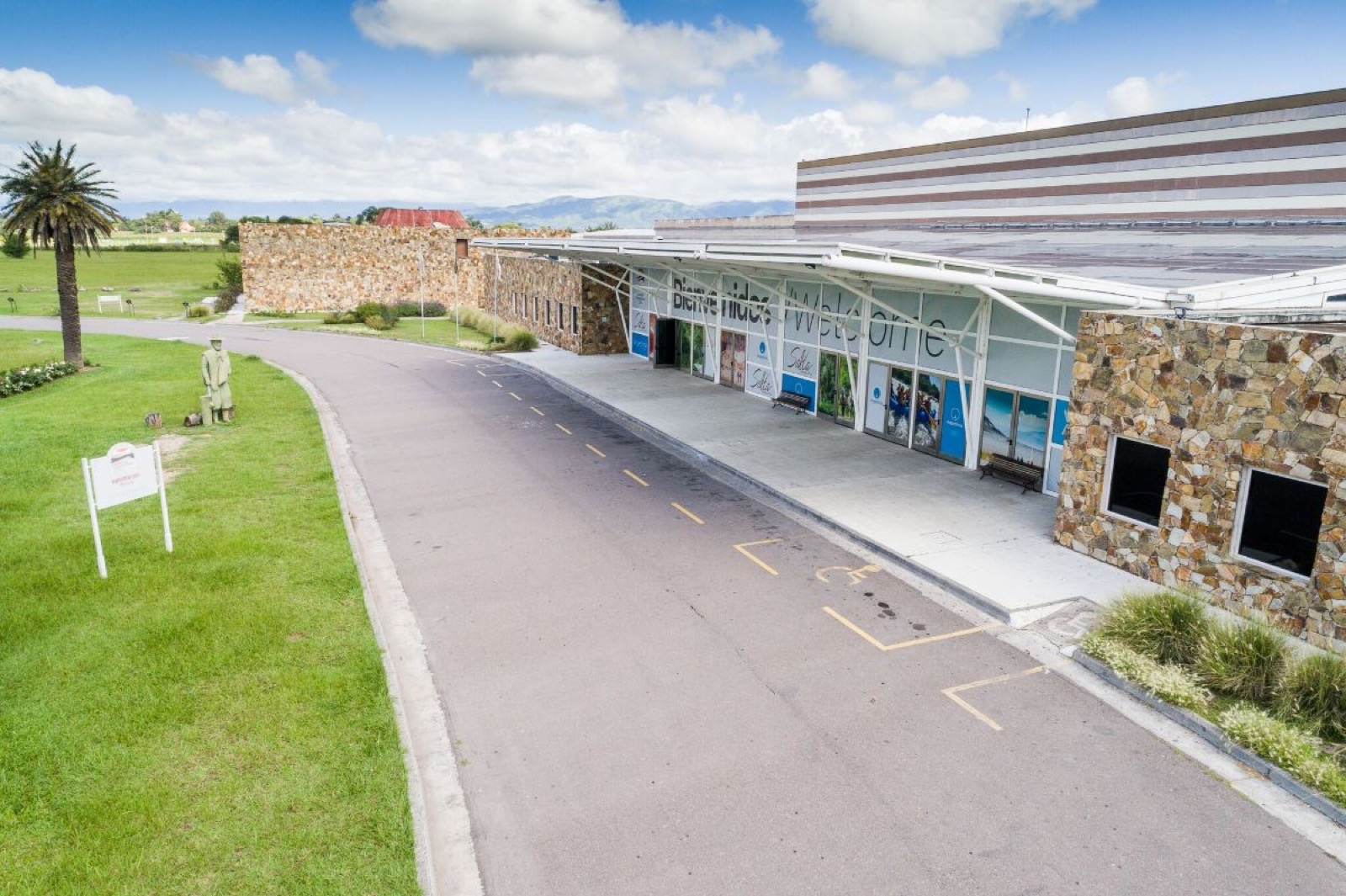
Argentina Space 2026 — Argentina driving the New Space Economy took place on 11, 12 and 13 November 2026 at the Salta Convention Centre. It was the first major national gathering of the space, technology and science industry, bringing together agencies, companies, universities, startups and investors from Argentina and around the world.
If you want to be part of the founding core of New Space in Argentina and join future editions as an exhibitor, sponsor or attendee, write to us at marketing@argentinaspace.com. More information at argentinaspace.com.